
Top 11 Digest Diff Alternatives in 2026
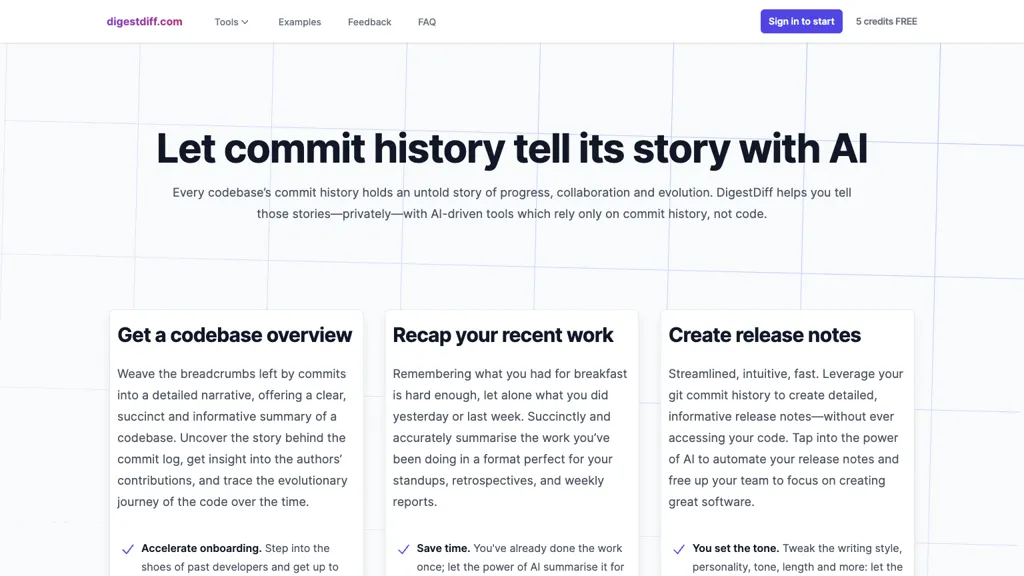
No user reviews yet FreeDigestDiff analyzes GitHub commit history to generate concise codebase overviews, standup updates, and release notes. It highlights authorship, feature progress, and milestones, aiding onboarding, project tracking, and markdown‑ready release documentation.
We've ranked 11 Digest Diff alternatives, including 6 with a free plan. Rankings are based on feature coverage and user feedbacks.
Top-rated alternatives include Releasesnotes, Gitmore, and WhatTheDiff.
11 Digest Diff Alternatives & Competitors, Ranked by User Reviews
Click Compare on any tool to compare it side-by-side with Digest Diff.
 #1
Releasesnotes
#1
Releasesnotes
ReleasesNotes automatically converts GitHub and GitLab commits into structured release notes. Users filter by date, author, or keyword; the AI compiles new features, bug fixes, and enhancements into a unified document, cutting manual writing and speeding release cycles.
 #2
Gitmore
#2
Gitmore
Gitmore connects GitHub, GitLab, or Bitbucket via OAuth/webhooks to monitor commits, PRs, merges and issues, providing AI-generated daily/weekly email or Slack reports, blocker detection, a real-time PR dashboard, and context-aware repository chat — metadata-only.
 #3
WhatTheDiff
#3
WhatTheDiff
AI‑powered assistant that auto‑generates pull request descriptions, summarizes changes, and creates changelogs for GitHub and GitLab. It sends notifications, supports inline refactoring, offers granular settings, provides a public changelog, and exposes a JSON API—without storing code.
 #4
Ellipsis
#4
Ellipsis
Ellipsis.dev automatically reviews every GitHub commit and pull request, detecting bugs, anti‑patterns, and style issues. It generates summaries, async fixes, and test‑ready changes, and offers weekly change logs in a SOC 2‑compliant VPC environment.
 #5
devActivity
#5
devActivity
##devActivity is a GitHub‑integrated analytics tool that collects only commit and issue metadata to provide AI‑driven insights on cycle time, bottlenecks, and team performance. It automates reviews, retrospectives, and gamified engagement for developers and managers.
 #6
Gitlights
#6
Gitlights
GitLights is a GitHub analytics platform that uses AI to provide insights into repository performance, tracking commits, pull requests, and developer skills. It offers advanced reporting, benchmarking, and an intuitive dashboard for improved decision-making and collaboration.
- Catch deals before they expire
- Unlock tools matched to you
- Show off your AI stacks
Already a member? Sign in
 #7
Giteai
#7
Giteai
GiteAI automatically generates commit messages by analyzing code changes, supports customizable templates such as Conventional Commits, provides searchable logs, project metrics, and security alerts for vulnerabilities, freeing developers from manual documentation.
 #8
Gitstart
#8
Gitstart
GitStart converts tickets into complete specifications by pulling data from codebases, Figma, Jira, Linear, and GitHub, enabling AI to generate merge‑ready pull requests with quality checks and fine‑grained security controls to shorten cycles and improve code quality.
 #9
AICommit.app
#9
AICommit.app
AICommit is a JetBrains IDE plugin that auto‑generates context‑aware commit messages from the staged diff with a single click. It processes diffs locally, offers preset or custom prompts, supports multiple AI back‑ends, and keeps history in the IDE.
 #10
Snapshot Reviews
#10
Snapshot Reviews
Snapshot AI analyzes code, commits, pull requests, reviews, and tickets using semantic NLP to surface bottlenecks, hidden expertise, reopened issues, and risk patterns; it generates automated changelogs, prioritization insights, and dashboards linking engineering metrics to business impact.
 #11
Wellcode CLI
#11
Wellcode CLI
Wellcode CLI is an open-source command-line tool for analyzing engineering team metrics. It integrates with GitHub, Linear, and Split.io to track performance indicators, monitor workflows, and optimize coding efficiency through data-driven insights.